A Final Thanksgiving
A Mother and her Son

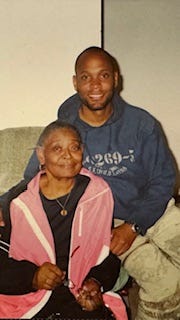
Do we ever really know when we’re seeing someone for the last time? Are the clues tucked inside words left unsaid and gestures left hanging? Does something in us rise up to warn us—a quiet chill, a prickle at the back of the neck? How do you prepare to say goodbye to someone while convincing yourself you still have all the time in the world?
I didn’t know it then, but I was flying home to a goodbye I didn’t yet recognize. Thanksgiving 2006 would be the last holiday I’d spend with my mother, though nothing about that morning hinted at an ending. I just knew I was going home—something I hadn’t done much since moving to New York.
And somewhere on that flight, as the world sped beneath me at thirty thousand feet, a familiar memory rose up—one of those holiday mornings that felt like a lifetime ago.
My mother would start cooking in the quiet, pre-dawn hours. Somewhere between deep sleep and consciousness, I’d hear the clanking of pots and pans in the kitchen, then the smell of onions and garlic drifting through the air like slow-moving clouds. Those smells still take me back to my childhood.
In my mind’s eye, I can still see her clearly on those holiday mornings in the kitchen—wearing her earth-toned house-dress, hair curlers peeking from beneath the scarf on her head. The kitchen felt warm and alive, not just from the heat of the oven, but from the love and care she poured into every meal.
By noon, the table was heavy with everything from turkey and dressing to mac and cheese, with all the familiar southern staples in between.
Dessert followed—sweet potato pies in a row, each a slightly different shade of brown—depending on how much cinnamon dusted the top, and a bubbling peach cobbler that filled the house with a scent that felt ancestral. It was the scent of survival and sweetness—the scent of Black women who had once made miracles from scraps given by their enslavers. Black homes have always been able to make something out of nothing.
That Thanksgiving, we went to my sister-in-law’s parents’ house, and looking back, I think some part of my mother already knew what the rest of us were afraid to acknowledge.
In my lifetime, my mother had always been a solid woman. I’d seen photos of her younger, slimmer years—she was striking then, a beauty that still lingered even as time caught up. But now, she was frail—more so than the last time I’d seen her. Clothes draped from her frame like they no longer knew the shape they were made for. COPD had kept her on constant oxygen since 1997, and though I’d grown used to the sight of the clear tubing across her cheeks that rested there like a permanent thread, it still hit me like the first time. Seeing her like that made death feel real.
She hugged me, her arms light but warm, and said, “I’ll be okay, baby.”
I wanted to believe her. And because I trusted her, I let that belief carry me, convincing myself that she’d always somehow be okay—that I’d have my mama forever.
That was the lie I told myself.
At the dinner table that day, she sat peacefully, her eyes roaming from face to face as if she were memorizing us all. I caught a glimpse of her gently touching my niece’s ponytail, her hand lingering a little longer than necessary. Behind her slightly fogged glasses, her eyes glowed as if there were no place in the world she’d rather be than right there, with the people she was with.
She didn’t say much—just smiled and laughed softly at the conversations swirling around her, the small talk and laughter that bring people closer, if only for that one day.
“Baby, get me a plate,” she said finally. “Not too much—just a little bit of everything.”
“Okay, Mom,” I said.
I remember how she watched me as I filled her plate, her eyes following my every move like she was storing the moment for later.
“Not too much now,” she repeated, looking attentively over the brim of her glasses.
I brought back a spoonful of everything—a taste of the whole celebration. She looked at the plate and smiled with a gratitude that went deeper than words.
“Thank you, baby,” she said softly. Then she closed her eyes and bowed her head for a silent prayer.
I didn’t know it then, but that prayer said more about where she was with God than anything she could’ve spoken aloud.
In those last few years, my mother turned back to the Bible and scripture more than ever. She’d always been a Christian, just not practicing. She used to say she didn’t like the hypocrisy you’d often see in church—and the way people used God’s name to justify their own judgment.
And with two gay sons, she wasn’t blind to how church folk treated those they deemed unworthy. “I don’t need a church to tell me how to love my children,” she’d once said.
Maybe she was seeking peace, or maybe she was just getting her house in order, the way people do when they know time’s getting short.
A few months before that Thanksgiving, I came home to check on her. She’d been in and out of the hospital so much that year. Her living room had become a mix of comfort and medical necessity—pill bottles, water bottles, and an oxygen machine that hissed until the sound felt like part of the room itself—so present that if you walked too far in any direction, you might’ve bumped right into the sound itself.
That hissing sound still lives in my head rent free—the sound of life holding on, one breath at a time.
I brought her flowers that day—a bird of paradise. She’d always admired that flower. It wasn’t the most fragrant, but its bright colors and sculpted shape carried a kind of peace that calmed a room. She smiled when I set them on the table, then gave me that familiar look—part pride, part curiosity, like she was taking inventory of who I’d become.
“You haven’t worn a yellow shirt since you were a little boy,” she said.
I laughed, caught off guard by her memory. “Wow, you remember that?”
“Of course I do,” she said, drifting into the memory.
I had been about seven years old, outside playing when a bee stung me on the neck, right below my collar, and fell into the back of my shirt. I ran into the house screaming and crying like my life was hanging by a thread, and afterwards, I swore off the color yellow forever. Somehow, in my child’s mind, the bee and the color fused into one fear.
What amazed me most wasn’t that she remembered—it was that she’d carried it all these years, quietly tucked somewhere between motherly instinct and love. We’d never spoken about that moment again after it happened, but here she was, nearly thirty years later, pulling it out of time like plucking a single strand of hair from her head for observation.
It made me realize how much mothers hold onto—the small things we forget that they never do.
My mother kept studying me as I sat there. Meanwhile, I tried to hide my concern that her living room now looked more like a hospital room. Her eyes shifted—soft, pained, thoughtful.
Then, almost in a whisper, as if someone in the next room wasn’t meant to hear, she leaned forward to the edge of her chair, getting a little closer to me, and said, “You know, it does say in the Bible that homosexuality is wrong.”
I didn’t know how to respond, or even if I should. The words hung there, heavy enough to fill the silence between us. The room shrank to the hiss of her oxygen machine.
In all the years since I’d been outed at sixteen, my mother had never rejected me. She’d been protective—sometimes overbearing—but never made me feel that who I was was wrong. She often said she was proud of her two gay sons.
So hearing her say those words now made me sad—not because of what she said, but because she felt she had to. I understood it wasn’t cruelty—it was fear. She was trying to make peace with her God before she met Him, maybe hoping that saving one gay son would let her see both of us again in heaven.
She looked at me, then lowered her head, almost in shame, like she wished she could pull the words back in. Her Bible rested in her lap, her hand mindlessly rubbing the same scripture page again and again.
Looking back, I think she was trying to reconcile the parts of her life that didn’t fit neatly into scripture—trying to make sense of loving me as I was while fearing what her faith told her to fear.
And I loved her enough to let her have that.
But that was all before Thanksgiving—before the last meal we’d ever share.
Later that night, after I dropped her off at home, I gave her a big hug and kissed her on the cheek goodbye. I was flying back to New York the next day and told her I’d call when I landed. I had just made a few steps down the walkway when I heard her call out from the porch.
“Wait—I almost forgot,” she said, almost gleefully.
When I turned around, she was standing in the doorway holding a wrapped gift.
“It’s your Christmas present, just in case you can’t make it home next month.”
Almost every year since I’d moved away, she still bought me a Christmas gift, usually sent by post, since I was often in some far-off place during the holidays. That year it was a black cashmere sweater, one I still own to this day—dry cleaned, folded neatly, tucked away like something sacred.
“Thank you, Mom,” I said. I leaned in for another hug, and this time she held on like she didn’t want to let go.
It was the same kind of just in case embrace she’d given me years earlier, back in 1994, when I moved to Atlanta. I’d dropped her off at work that morning before driving across the country. She was going to skip work that day to see me off, but I convinced her it wasn’t necessary.
She got out of the car, gave me a quick hug and a kiss, and started walking toward the front door of the building. Then she stopped—stood there for a beat—before turning all the way back around and coming to the car again.
She opened the door and hugged me a second time.
A longer hug.
A deeper one.
A mother’s “just in case” hug.
The following morning on my flight back to New York, I thought a lot about my mom, and that hug. I hadn’t planned on coming home for Christmas, but I began to have second thoughts. I finally admitted to myself that I probably didn’t have very many holidays left to share with my mother.
On December 22nd, 2006, I was in London, walking back to my hotel from a bar in Kensington. It was a little after 11 p.m., and two of my colleagues and I were making our way down a dark, tree-lined street. I had just told them that after this trip, I’d decided to fly home for Christmas to see my mother.
Then, almost as if the universe had been listening, my cellphone rang—sharp against the quiet of the street, urgent in a way that tightened something in me.
The number wasn’t familiar. And in 2006, you didn’t answer an international call unless it was absolutely necessary. So I let it go to voicemail.
But it rang again.
Immediately.
Same number.
Something in me—instinct or intuition or maybe just a pull I couldn’t name—told me to answer.
“Hello?” I said.
On the other end, I heard my niece’s voice—breaking, trying to steady itself under the weight of emotion.
“Nana just died,” she said.
I stopped walking, not realizing I was in the middle of the street. My colleagues stopped too, watching my face.
For a moment, the entire street went still.
The distant London noise dimmed like someone lowering a volume knob.
All I could manage was:
“Okay.”
Grief does something strange to memory. It sends you backward.
When I was in kindergarten, my mother used to stand at the end of our driveway and watch me walk to school. It wasn’t far—a block and a half, but I treated that distance like it was a thousand miles. Every ten or fifteen steps, I’d stop and turn around, just to make sure she was still there. And she always was. She’d raise her hand and wave, and only then would I keep going.
Right before crossing the street, I’d turn and wave again, then look both ways and cautiously make my way across.
And right before walking through the school’s gate, I’d turn a final time to see her still standing there—making sure I made it safely.
I didn’t understand it then, but I’d spend most of my life doing the same thing—turning back, checking to make sure my mother was still there, still loving me from whatever distance life placed between us.
And for thirty-four years, she was.
Even now, when I’m deep in thought and her memory slips into my mind, I find myself back at that crosswalk—five years old again, pausing before the street. I turn to see her standing there, just like she always did. But sometimes, in that memory, she turns first. She gives me one last look, then walks back toward the house.
And I’m not afraid.
I don’t feel abandoned.
I just feel… ready.
Ready to cross the street, even though she’s not there watching.
It took losing her to understand she had been preparing me my whole life for that moment—when I could finally take a breath, face forward, and keep walking.
I cried through the whole story.. it made me think about how I could’ve been a better daughter. Sometimes I was just so callous what’s her heart and all she wants to do was love me. I miss her every day. She was a good mother, and we were blessed to have her.
Reading this made me cry like a baby. I think about my mom all the time. I was very fortunate to have her for so long in my life. She passed away in 2022 the same day that her mother was born. I can totally relate to how you feel hugs my friend.